
The Wise Report Provides Government Updates for Areas of Interest to HGS Professionals.
Check out the Latest Wise Reports below...
Release Date: 26 November 2014
Release Date: 15 November 2014
Release Date: 1 November 2014
Release Date: 1 November 2014
Release Date: 1 November 2014
Release Date: 15 October 2014
Release Date: 4 October 2014
Release Date: 1 October 2014
Release Date: 1 October 2014
Release Date: 29 September 2014
Release Date: 13 September 2014
Release Date: 2 September 2014
Release Date: 1 September 2014
Release Date: 1 September 2014
Release Date: 17 August 2014
Release Date: 21 July 2014
Release Date: 10 July 2014
Release Date: 9 July 2014
Release Date: 5 July 2014
Release Date: 28 June 2014
Release Date: 13 June 2014
Release Date: 1 June 2014
Release Date: 1 June 2014
Release Date: 24 May 2014
Release Date: 18 May 2014
Release Date: 15 May 2014
Release Date: 1 May 2014
Release Date: 1 May 2014
Release Date: 18 April 2014
Release Date: 18 April 2014
The Houston Geological Society is powered by a community that cares.
Your donation supports students, technical programs, outreach, and the partnerships that strengthen our geoscience community. If HGS has helped you learn or connect, please consider giving back

The Wise Report
Henry M. Wise, P.G.
November 26, 2014
While the State Legislature meets in January, bills are already being filed. There are currently eight filed bills that may be of interest to Texas geologists:
HB 163, by Larson, Relating to interstate cooperation to address regional water issues. Sets up the Southwest Water Commission to discuss water needs of the region with other states and Mexico. Filed 11/10/2014. For more information go to: http://www.capitol.state.tx.us/BillLookup/History.aspx?LegSess=84R&Bill=...
HB 190, by Burkett, Relating to the regulatory analysis of rules proposed by the Texas Commission on Environmental Quality. Sets up guidelines for TCEQ analyses. Filed 11/10/2014. For more information go to: http://www.capitol.state.tx.us/BillLookup/History.aspx?LegSess=84R&Bill=...
HB 201, by Leach, Identical to companion bill SB 109, Relating to the procedure for action by the Texas Commission on Environmental Quality on an application for a water right. The bill sets up deadlines for reviews of applications by the TCEQ. Filed 11/10/2014. For more information go to: http://www.capitol.state.tx.us/BillLookup/History.aspx?LegSess=84R&Bill=...
HB 281, by Simmons, Relating to a limitation on the expansion of certain landfills. This is for Type I municipal solid waste landfills that are located in a munipality in a county with a population of more than 600,000 persons and not more than 500 feet from another municipality. Filed 11/12/2014. For more information go to: http://www.capitol.state.tx.us/BillLookup/History.aspx?LegSess=84R&Bill=...
SB 77, by Ellis, Relating to the development of a climate adaptation plan by certain entities. By 9/1/2016 twelve governmental entities, including the TCEQ, General Land Office, and the Texas Water Development Board, and every four years thereafter, shall publish a climate adaptation plan that will assess the entity's role with respect to climate change. Received by the Secretary of the Senate 11/10/2014. For more information go to: http://www.capitol.state.tx.us/BillLookup/History.aspx?LegSess=84R&Bill=...
SB 78, by Ellis, Relating to the procedure for action by the Texas Commission on Environmental Quality on an application for a water right. The bill sets up deadlines for reviews of applications by the TCEQ. Received by the Secretary of the Senate 11/10/2014. For more information go to: http://www.capitol.state.tx.us/BillLookup/History.aspx?LegSess=84R&Bill=...
SB 109, by Taylor and Van, Identical to companion bill HB 201, Relating to the matters to be considered in developing the state water plan. Future water availability and water use must be considered. Availability includes conservation, purification and reuse. Received by the Secretary of the Senate 11/10/2014. For more information go to: http://www.capitol.state.tx.us/BillLookup/History.aspx?LegSess=84R&Bill=...
SB 118, by Taylor and Van, Relating to unit operations for oil, gas, or oil and gas production from depleting reservoirs or carbon dioxide storage; authorizing a fee. Received by the Secretary of the Senate 11/10/2014. For more information go to: http://www.capitol.state.tx.us/BillLookup/History.aspx?LegSess=84R&Bill=...
I'll be updating this list in the future, throughout the upcoming legislative session.
Henry M. Wise, P.G.
The Wise Report
11/26/2014
It’s November, time for Thanksgiving and giving thanks. I’m thankful for many things, but what if at the same time I asked you “What about you?” Not only what are you thankful for, but what about you? This month I want to look at those two questions. What am I thankful for? There are the big and obvious things: life, family, job, health, living in America, working in the oil industry, unconventional resources, the price of oil, and those are just the more obvious items. There are some things that are also taken for granted; friends, memories, and waking up each morning. What should you be thankful for? I suppose that depends upon whether I am asking the experienced hand or the young professional. I am going to ask the young professional because this year may be the first year that those with less than ten years’ experience get to ponder the possibility of employment changes that they have not initiated. There have not been any big employment announcements for E&P companies. There is no apparent reason that one should worry. However, some layoffs have been announced in the local paper by service companies earlier this year. And in August, by word of mouth, one company reduced its exploration staff. Never having experienced that kind of trepidation can make one think harder about what they should be thankful for each day. I bring this up because historically it has been interesting how involvement in HGS increases when layoffs occur. Membership numbers also rise. Speaking of membership, have you renewed your HGS membership for 2014-15? The HGS membership report for August showed that some 1900 members had not yet renewed their dues. If you didn’t renew, October was the last time you received the Bulletin and you lost access to the members’ only portion of the HGS web site. So as Thanksgiving approaches I would like to remind the HGS members about what you get for $28.00 each year: a first class Bulletin; a vibrant web site with lots of reference material; professional development opportunities that your employer may not be aware exist; network opportunities that you may not appreciate today or that may take some time to pay dividends; the opportunity to educate your peers; the opportunity to build not only oil industry history, but also HGS history. Why is this important? HGS will turn 100 years old in August 2023! How does my second question come about? I attended the International Dinner Meeting held on September 8 at the Westin Hotel. I was enjoying my conversation with my dinner companion, but realized that I was talking but – he was asking – he was learning, and I didn’t know a lot about him. So I turned the tables during a small lull and asked “What about you?” Those three words were an epiphany for me and I suggest that they might open doors for you.
What a surprise!! He responded and I learned that he:
•Had a geography degree from UCLA
•Had served in the US military
•After discharge had moved to Hawaii and worked for the State as a Social Worker
•Got hired by the FBI
•Moved to Houston
•Now heads the area antiterrorist task force for West Africa
in Houston
•Wanted to understand better the influence and impact the
oil industry and geology have on West Africa
•Looks at these and similar professional society opportunities as a way to enhance the capabilities of the FBI to study how possible threats might develop. Geology is coming to the forefront of the public interest more today than ever before. It is not limited to rocks and oil or gas.
We have tsunamis, volcanoes, global warming, ice cap loss, drought and shrinking aquifers, fracing reservoir concerns, and injection well concerns. Geology the science is now more than ever becoming a public and political topic. Items that used to garner five lines on the back page of the business section now become headlines on the front page. Geology and geologists are no longer “under the radar.” Amazing when you ponder all of this.
Let me return to my previous ponderings, what about you? What hidden talents are lying dormant? What “bucket” items might you check off by serving your professional society? Education? Education or public outreach? Event organization? Leadership? In the next ten years, HGS will need the young members of today to be the experienced members of tomorrow. Besides the conventions in 2015 and 2017 other conventions are scheduled for 2020 (GCAGS) and 2022 (AAPG). We have not even begun the planning for our 100th anniversary in August 2023. We need volunteers to step forward for our vacant committee posts. HGS needs young professionals to step forward and participate in committees and to stand for office. Without you, the young professionals, HGS cannot continue to grow and serve the community. Young professionals, NeoGeos, what about you? My “Look Back in Time” articles showed the support of management and encouragement of young professionals to participate in local professional society activities in the fifties and sixties. I challenge today’s companies to return to that time when professional society involvement was expected, not just something that was listed on a resume or vita. The African Conference seems to have been a huge success. The short course preceding the conference had 54 attendees. The original expectation was for 30. With exhibitors and walkups, Martin Cassidy reported the overall attendance was at or near 450 people. My congratulations to the Conference Chairmen and their committee for all their efforts. The Annual HGMS Gem, Jewelry, Mineral, and Fossil Show (http:// hgms.org/ click on Annual Show) runs from November 7th through the 9th at the Humble Civic Center. Janet Combes could use some help (281-463-1564).
We finally received 25% of the expected proceeds from the 2014 AAPG ACE held in Houston. Past President Barry Katz requested those funds last May per our contract with AAPG. Given that money, what that means for our full share, and the monies received from the 100% HGS-run events at the ACE, we had a very profitable 2014 ACE with AAPG. General Chairman Steve Brachman and his entire committee deserve a big thanks for their efforts.
I have to come back to some key thoughts:
•Being a professional society member is part of your professional development.
•Professional society membership is more than having your name in a directory.
•Networking is not just about compiling a list of contacts.
•You never know which event can profoundly impact your future.
So, I ask, What about you? Will you answer the call? Will you be thankful for the opportunity to serve your professional society when it’s your turn to write this column?
If you ask my mother, it was always obvious that I would be a geologist. According to her, from the moment I could walk I was collecting rocks. Of course, she has forgotten that I also liked to eat paste (not sure what career that would lead to) and she tends to confuse geology with archeology. In fact, I knew nothing about geology until my junior year of high school. I was interested in biology and planned to be a marine biologist. One of the required courses in my school was Physical Geography, taught by Mr. Duane Tonn. One of the requirements for his course was that each of us create a country, complete with climate, landforms and natural resources. This exercise forced me to consider things I had previously either taken for granted or simply didn’t pay attention to.
For example, water didn’t “spring” into existence at the tap, but had to be stored somewhere below ground. Building materials, such as sand, gravel and cement, were not created at the hardware store. The gasoline to drive the vehicles used by citizens of my newly created country was not generated at the local service station. It was while looking at each of these in more detail that I discovered a new and interesting passion – geology. I don’t remember how well I did on the exercise, but I do clearly remember the moment the light went on and I found something that I could devote my life to. After earning both a BS and an MS in geology, it was time to earn a living. I specialized in hard-rock geology and it was not at all obvious how my degrees could be used to generate an income. Through an interesting series of events, I ended up being hired by Mobil and began work in their Denver office. Here I had the opportunity to meet a man that would have a huge influence on my career. Mr. C.E. “Ole” Carlsen was a geologist who had risen high in the management ranks in Mobil. He decided that he wanted to spend more time working with young geologists and stepped down from his management position to give himself time to do this. His constant advice and encouragement, as well as his ability to “guide” a headstrong young geologist, have served me well for the past 30+ years. Ole was an advocate of taking training courses related to subjects that were outside of your discipline. He “encouraged” me to take courses in Reservoir Engineering, Well Drilling and Completion, Economics, Geochemistry and Geophysics. His belief was that you didn’t have to be an expert in all fields, but that it was important to have enough knowledge of a topic to ask the right questions and to understand when you were being told things that didn’t seem to make sense. These two men, one of whom introduced me to geology and the other who taught me how to be a professional geologist, have had an incredible inf luence on my life and career.
I try to incorporate the lessons they taught me, when advising younger colleagues and to keep the thrill of discovery and learning intact in my personal and professional lives. Thank you, Mr. Tonn and Ole. I never expected that my life would turn out as it did and am grateful for your advice and instruction. Do you have a Mr. Tonn or an Ole in your career? Tell others about them, and why not send your stories about them to the Editor of the HGS Bulletin for possible publication.
The Wise Report
Henry M. Wise, P.G.
November 1, 2014
Consistent with changes enacted into state law in 2013, the Texas Commission on Environmental Quality (TCEQ) will return to being the sole preconstruction air-permitting authority in Texas, including for permits that address greenhouse-gas emissions.
This change marks a departure from the previous two-tiered system in which the TCEQ issued federally required Prevention of Significant Deterioration (PSD) permits for “traditional” pollutants and the U.S. Environmental Protection Agency issued PSD permits for greenhouse-gas emissions.
To foster continued economic prosperity in Texas, the state has worked diligently to become the greenhouse-gas permitting authority while also vigorously opposing select components of the EPA’s greenhouse-gas permitting program in the court system.
“While the State of Texas continues to disagree with the EPA program to regulate greenhouse-gas emissions, the TCEQ has a system in place to ensure timely permitting that provides stability and predictability to our State’s regulatory framework,” said TCEQ Chairman Bryan W. Shaw, Ph.D.,P.E.
TCEQ personnel already review hundreds of air-permit preconstruction authorizations each year, including a number of PSD permits. This extensive permitting experience and technical expertise make the TCEQ’s permitting staff well-equipped to ensure technically sound and prompt review.
For more information contact Terry Clawson, 512-239-0046.
---------------------------------------------------------------------------------------------------------------------
The Railroad Commission of Texas (RRC) adopts amendments to §3.9 and §3.46, relating to disposal wells, and fluid injection into productive reservoirs, with changes from the proposed text published in the August 29, 2014 issue of the Texas Register (39 TexReg 6775). The adopted amendments incorporate requirements related to seismic events in connection with disposal well permits, monitoring and reporting.
For more information go to: http://www.rrc.state.tx.us/media/24613/adopt-amend-3-9and3-46-seismic-ac...
Henry M. Wise, P.G.
The Wise Report
11/1/2014
The Houston Geological Society will host the 65th Gulf Coast Association of Geological Societies (GCAGS) Convention at the George R. Brown Convention Center, September 19-22, 2015. The GCAGS is also known as the AAPG Gulf Coast Section. All current members of the HGS, South Texas Geological Society, NOGS (New Orleans Geological Society), Austin Geological Society, Lafayette Geological Society and Corpus Christi Geological Society, and a few other societies, are members of GCAGS. Learn more at www.gcags.org! GCAGS does not charge any member dues. Dues to AAPG, and to the local Gulf Coast societies, are your invitation to participate in upcoming GCAGS conventions and social events. The Gulf Coast Section of SEPM (GCSSEPM) plans to co-host the GCAGS 2015 convention. GCSSEPM will be organizing oral talks, posters, judging and the SEPM awards program.
The 65th Annual GCAGS convention will feature Gulf Coast area oil, gas and environmental topics, with the intent that Gulf Coast geoscientists will expand their technical training, knowledge and networking during the convention. The General Chair of the convention is Larry Bartell (Legends Exploration, email ldbartell@legendsexpl.com). GCAGS President for the 2015 convention is Charles Sternbach (Star Creek Energy, carbodude@gmail.com). GCAGS Non-Technical Chair is Deborah Sacrey, HGS President-Elect. The Technical Program is coordinated by Linda Sternbach (Star Creek Energy) Dianna Phu (dianna@exabyte.org) is both Secretary for the convention and publicity, website and social media chair. Mike Erpenbeck is convention Treasurer. The last GCAGS convention held in Houston was in 2008; Ken Nemeth was GCAGS President and Dave Rensink was General Chair. Larry Bartell was also the General Chair for the 2000 Houston GCAGS convention.
The pre-convention activities will start on Saturday, September 19, 2015. The opening weekend will kick off with one and two-day field trips, leaving from the George R. Brown Convention Center. These will be open to professionals and university students.There will also be one day technical short courses on the weekend of Sept 19-20, 2015.
The talks and poster sessions will occupy two full days and will be held on the third level of the George R. Brown Convention Center from September 21-22, 2015 (Monday and Tuesday). 100 or more talks, in concurrent sessions, are anticipated to be included in the technical program.
The Houston 2015 GCAGS convention is opening up a “Call for Papers”, and inviting geoscientists to submit a short 250 word abstract with title and authors by December 13 2014. Submit a short word document (300 words) to Technical Program chair Linda Sternbach at linda.sternbach@gmail.com, or check the convention web page and blog hosted by GCAGS Secretary Dianna Phu at www.gcagshouston.com.
The 2015 session themes are: New Oil and Gas Discoveries, Unconventional Plays, Development Field Studies, GOM Shelf and Onshore plays, Salt Tectonics and Traps, Mexico and Caribbean Plays, Geophysical Technology, Gulf of Mexico Deepwater, Environmental Geology, Coastal Geology and Surface Impact, Geology-Geophysics-Engineering, Business Portfolio Management, and Climate/ Public Awareness Issues.
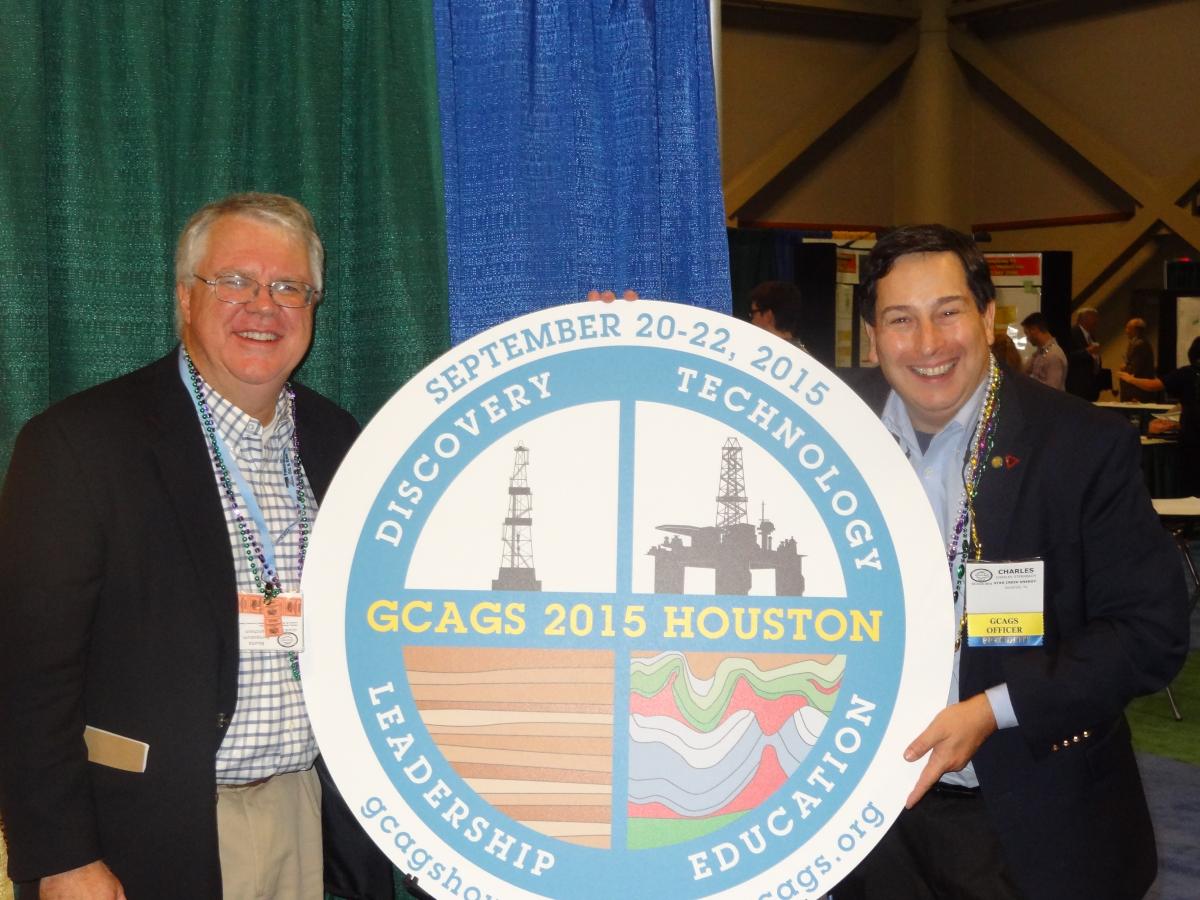
The 65th Annual GCAGS convention has a specially designed logo created by Charles Sternbach and HGS Bulletin design editor, Lisa Krueger. The round logo has the words: “Discovery, Technology, Leadership and Education” around the outside ring. The center features graphics of an onshore rig, offshore rig and shale strata and offshore salt basin. The committee suggested this combination of images for the 2015 GCAGS logo because the convention will be incorporating technical topics on both onshore and offshore Gulf of Mexico, and also the Mexico/Caribbean areas, with the goal of bringing together experienced professionals with young professionals and geoscience students.There are other projects initiated by GCAGS that deserve mention. There will be a GCAGS Transactions publication of all the talks and posters at the 2015 convention. This editor of the 2015 Transactions is past HGS President, Steve Levine (stephenlevine@sk.com).
In addition, GCAGS has a peer-reviewed technical publication called GCAGS Journal that publishes full length geoscience-related papers each year in hard copy and online as pdfs.The GCAGS Journal started in 2012.Past papers can be found online at http://www.gcags.org/Journal/GCAGS.Journal.Archives.html.The 2015 GCAGS Journal Editor is HGS Past-President and former HGS Bulletin Editor, Barry Katz. Geoscientists will need to submit a 600 word abstract explaining their submission by December 2, 2014. Contact Barry Katz at barrykatz@chevron.com for more information. GCSSEPM Editor will be Patricia Santogrossi, past HGS Bulletin editor.Check the convention website www.gcagshouston.com for more information on contacting all the volunteers and log on for the latest news as the convention planning continues from now till mid-2015. Convention registration will open in August 2015.
"Good communication is particularly important to GCAGS, its approximately 10,000 members, and its 13 affiliated member societies."
Read the open letter from the GCAGS President, Charles Sternbach.

The Wise Report
Henry M. Wise, P.G.
October 4, 2014
The public comments period for the 2014 Texas Board of Professional Geoscientists (TBPG) is now closed. If you would like to see what comments were made, go to: http://tbpg.state.tx.us/wp-content/uploads/2014/10/PublicCommentsThrough...
Thanks to Charles Horton, TBPG Executive Director for the link.
---------------------------------------------------------------------------------------------------------------------
The Texas Commission on Environmental Quality's (TCEQ's) publication "Natural Outlook" has an interesting article on the EPA's proposed new ozone standards. It appears that the proposed ozone standard may actually increase the number of potential deaths in some areas, like Houston and Los Angeles. To read the entire article, go to: https://www.tceq.texas.gov/publications/pd/020/2014/will-epas-proposed-n...
Henry M. Wise, P.G.
The Wise Report
10/4/2014
If it’s August in Houston it’s October HGS Bulletintime! I attended the AAPG Leadership Days in Snowbird, Utah from August 8 to 10. Getting that close to awesome geology was quite an experience. Walking at 8,400’ elevation was not such an awesome experience though. Meeting old friends from around the world and making new ones reminded me of two key points:
•Geologists have a passion for science.
•Participation in a professional society should be part of everyone’s development plan.
A geologist’s passion for science is life-long. It is rocks and minerals, electric logs and seismic lines, geochemistry and basin analysis, lease sales and well sites; just to mention a few items. The passion is applied to “solving the puzzle” by creating a prospect and the satisfaction of seeing it drilled and completed. That passion can be seen in the euphoria of success and the woes spawned by a dry hole. I met several young professionals from Houston at this meeting. These young professionals have that passion for science and want to nurture it as part of their professional development. Experienced professionals have a passion for science that can provide the nurturing, encouragement, and mentoring that will develop our future professional society leaders.My desire is to bring those two passions together. Houston is well-represented in this group. One is a co-chair of the YP (Young Professionals) Committee of the AAPG. Another is the Gulf Coast liaison for student chapters. Two others represented Houston at the Young Professionals summit that took place the days preceding the conference. Those who will lead us in the future are the volunteers of today. I hope to have our own “summit” with these people in the near future and see how they can bring their passion to HGS in the best way.Not every young professional can find a spot in the national society. However, local and sectional societies offer opportunities to learn skills, find mentors, and take on leadership roles. I was amazed to see the number of young professionals in leadership positions in the Rocky Mountain Association of Geologists and the San Joaquin Geological societies. In fact, I believe that five of the six officers (including the President) for the San Joaquin Society are young professionals! The AAPG YP group is a little different than our NeoGeos because its members can have up to ten years of industry experience before moving out of the “young” category. I want to see a few passionate young professionals and NeoGeos in Houston become part of the future leadership for the HGS. The active participation and commitment of our young professionals is a must if we are to meet our vision and succeed in our mission.October brings us many events that offer educational opportunities, not only for the young professionals, but for the public as well. I encourage you to look at the events calendar and participate in these events. The 8th annual GeoScience Day will be held on October 16th (https://www.hgs.org/civicrm/event/info?reset=1&id=1471).
This year’s theme is The Life of an Oilfield, a valuable learning experience for those new to our industry.The experienced professionals will have an opportunity to get out twice this month and promote geology to the public. If it’s October, it’s time for Earth Science Week! This year’s Museum Day is set for October 11 while the popular field trip to Whiskey Bridge will be on October 19. The ESW committee again this year has arranged with AGI to publicize Earth Science Week which has been rebranded as Earth Science Week Houston (http://www.earthsciweek.org/eswhouston/index.html). There are a lot of neat things to discover on that page. This year’s theme is Mapping Our World and it presents a wonderful opportunity to go through the Wiess Energy Hall with your family. There are also webcasts available on the AGI web site that discuss the upcoming events. There has been a lot of activity “behind the scenes” by the many HGS committees but they can always use more help. The Society also has several vacant committee chair positions. If we are to promote our outreach programs we dearly need to fill those. If you have a leaning to education and youth, look into the Academic Liaison, Continuing Education, and Science and Engineering Fair Committees. If you like outdoor activities, the Tennis Committee Chair position is also vacant.Some things to note this month and next:
•The Board is discussing the General Lunch meeting possibility. Vice President Jordan’s survey had a 66% favorable vote but was equally split on where to hold the meeting, west side or downtown. The majority of those voting in favor of bringing back the lunch meeting (80%) attended two or fewer (out of 5) meetings last year.
•I urge you to register for the Legends Night in January. Space is limited. Walk ups will not be accommodated! This is a great opportunity to see the Undergraduate Foundation scholarship winners, maybe the Graduate Scholarship winners, and learn about the AAPG Imperial Barrel (IBA) Award.
•There has been some discussion regarding the update of the Walking Tour of Downtown Building Stones. If you are interested in assisting with such an endeavor, contact me.
•After 3 ACE conventions in 7 years (2011, 2014, and the upcoming 2017), AAPG won’t return to Houston until 2022.
Last month I urged experienced HGS members to take their favorite NeoGeo or Young Professional to a technical meeting. This month I am turning it around and asking the NeoGeos and Young Professionals to invite an Experienced Professional that they would like to meet to a technical meeting. Whether it is for networking, mentoring, history, or just plain storytelling, it will be a great way to make some new friends.
Passion is what drives us.
To do the work we do
it’s why we go to the office
And why we get to play...
With rocks
With apologies to Burma Shave
In my first column I wrote that I planned to share at least one of my more embarrassing professional moments. My hope is that other members will do the same, as I do believe that we are, as a profession, particularly good at laughing at ourselves. Now that the time has come in fact to write about one of my more embarrassing moments, I find I have quite a few to choose from!
Many years ago, with my previous company, we hosted senior management at least once a year for a review of our activity, and look ahead at our plans for the upcoming year. If possible, we liked to add something a bit “special” to these visits. This particular year, the decision was made to organize a field trip to the Wyoming Overthrust Belt, concentrated around the Jackson Hole, Wyoming area. A co-worker and I spent about two weeks in the field preparing the trip and putting together a guidebook, with photos, sketches, maps and commentary to help orient our visitors and provide a record of the trip. All was going well – we had the guidebooks prepared, the logistics arranged and a forecast of good weather for the time we were going to be there.There were three of us involved in running the trip. We arrived a day early to take an overf light of the area we would see on the ground, to make sure that this was a good option for the entire group as the last activity before everyone left to go back home. This was my first experience in organizing any type of field trip. I soon discovered, as anyone who has done this themselves can probably appreciate, that there is an incredible amount of behind the scenes effort required to run a smooth and successful trip. Everyone arrived as planned and got checked into the hotels. Dinner was fun and we were all looking forward to starting off early the next morning to see some geology. The first day went great. The weather was perfect and we were able to have very enthusiastic discussions while standing in front of some pretty spectacular outcrops. We got back to town relatively late, and while the others were refreshing themselves in preparation for the evening’s entertainment, the three of us were scrambling to gas up the cars, make sure that we really did have dinner reservations, ensure that box lunches for the next day were ready to pick up at 5:00 a.m. and go over the program for the second day.Finally, after dinner, it was time to collapse for a few hours – or so I thought. About 10:30 my phone rang and one of my co-organizers was on the line. One of the senior managers wanted to take us out to celebrate our successful first day and thank us for our efforts. This was probably one of the last things that I wanted or needed to do, but off we went. Of course, the senior manager felt that it was somehow rude to leave the bar before closing time, and we couldn’t very well leave him on his own. Return to the comfort of my hotel room was late, or early, depending on your point of view.
The next morning, after about two hours of sleep, we gathered everyone together and headed off to see our first outcrop of the day, one we felt was particularly important. We arrived at our destination and I began a fairly detailed explanation of why we were here and what we were seeing. Everyone was nodding in agreement. This was a good start to the second day, or so I thought. As we were returning to the cars, my co-organizer took me aside and told me that we had stopped at the wrong outcrop and the one we really planned to discuss was about a mile down the road. I called the participants together and admitted my mistake, asking that they remember everything that I had said so we could make more efficient use of our time once we arrived at the proper outcrop. I wanted to find a hole to crawl into and couldn’t believe that I had made this mistake. I had visions of my career dying before my eyes. Fortunately, the reaction of the group was fantastic. Comments along the lines of “If we were decent geologists, we should have noticed that we were in the wrong place.” “You had us convinced.” and “Can we build an open fire to cook lunch?” suggested that this was not the disaster I had feared. The rest of the trip went off without a hitch. For the next several years our annual review meetings tended to include at least one or two references to this incident – all in good fun (I think). I learned from this that a good sense of humor, at the right time, can help one to survive potentially embarrassing moments. The ability to find firewood and build a fire to cook lunch doesn’t hurt either. Until next month. Take care.
The Wise Report
Henry M. Wise, P.G.
September 29, 2014
Just a reminder that the public comment period for current proposed changes to the Texas Professional Geoscientist rules ends on October 2, 2014. If you are interested in commenting, submit all comments in writing to Mr. Charles Horton, TBPG, P O Box 13225, Austin, Texas 78711, or by e-mail to chorton@tbpg.state.tx.us. For more information on how to submit comments regarding the proposed rules go to: http://tbpg.state.tx.us/board/rules/rule-review/.
---------------------------------------------------------------------------------------------------------------------
The Texas Commission on Environmental Quality (TCEQ) proposes amendments to the effluent guidelines and standards for Texas pollutant discharge elimination system (TPDES) permits which is necessary to adopt by reference revisions to the United States Environmental Protection Agency (EPA) construction stormwater regulations, which were adopted in 40 Code of Federal Regulations (CFR) Part 450 and became effective on May 5, 2014.
The revisions to the federal regulations do not include any new regulatory requirements, but instead provides clarification to existing requirements and removes requirements related to the numeric turbidity effluent limitation. Specifically, the revisions include: defining "infeasible"; clarifying the applicability of requirements to control erosion caused by discharges; providing additional details on areas where buffers are required; clarifying requirements for soil stabilization, preservation of topsoil and pollution prevention measures; and withdrawing the numeric turbidity effluent limitation and monitoring requirements.
This rulemaking will amend §305.541 to adopt by reference revisions to 40 CFR Part 450, as published in the Federal Register on March 6, 2014 (79 FR 44). The clarifications added to the federal regulations will be incorporated into the Construction General Permit (CGP) at the time it is renewed in 2018. However, withdrawing the numeric turbidity effluent limitation in the federal regulations will not require a revision to the CGP, since this limitation was not incorporated into the 2013 CGP. In 2011, EPA stayed the numeric turbidity effluent limitation.
Currently, §305.541 adopts by reference certain parts of 40 CFR that were in effect at the time Texas was awarded delegation of the National Pollutant Discharge Elimination System (NPDES) program and specific parts that were adopted after delegation. This rulemaking will revise the reference to 40 CFR Part 450 to cite the Federal Register volume and date of publication related to the 2014 revisions to the construction stormwater regulations.
The earliest possible date of adoption is October 26, 2014. For more information go to: http://www.sos.state.tx.us/texreg/archive/September262014/Proposed%20Rul...
Henry M. Wise, P.G.
The Wise Report
9/29/2014
The Wise Report
Henry M. Wise, P.G.
September 13, 2014
The TCEQ updates to the Texas Risk Reduction Program (TRRP) Tier 1 Protective Concentration Levels (PCLs) are now available at: You http://www.tceq.state.tx.us/remediation/trrp/trrppcls.html.
The 2014 PCL table update is a single Microsoft Excel workbook with each table on a separate worksheet. The updates are also available as a print only Adobe Acrobat portable document format (PDF) file. The Excel file and the PDF file each contain PCL tables 1 through 10 and the supporting tables in the following order:
The PCL tables updated in June 2012 were the most recent tables prior to this release. A guide to the correct interpretation and use of the Tier 1 PCL tables can be accessed at: http://www.tceq.texas.gov/publications/rg/rg-366_trrp_23.html
For additional information on the PCL tables, contact Jessica Mauricio at jessica.mauricio@tceq.texas.gov
Henry M. Wise, P.G.
The Wise Report
9/13/2014
|
| I am rephrasing and including it as part of my first letter to you, because I think that such statements allow a writer to set out goals, are valuable pieces of our history, might encourage others to run for office in the future, and help complete the historical record. So what you missed in April 2013 is reprinted here with revisions and paraphrasing to make it current.
|
|
| Anyway, a relatively long expatriation, followed by a few others, turned out well. I am confident that editing the Bulletin will be a good experience, particularly as there is an incredible support team already in place. With the help of the office staff, editor-elect, guest editors, design editor and others, this promises to be a good year.
|
"What color do you want for the banner?” This question, posed to me a few weeks ago during an editorial team dinner, suddenly made my upcoming editorship of the Bulletin very real. I have to admit, I had a moment of panic. In some respects it was reminiscent of being informed that my request to go on expatriation had been granted. My wife and I had talked for a long time about living and working overseas and had finally agreed that this is what we wanted to do. When we were informed that I was being offered a position overseas (significantly farther south than we had expected) we immediately looked at each other and thought “What have we done?” As with many things in life, sometimes the idea of something is much more attractive than the reality of having it. Anyway, a relatively long expatriation, followed by a few others, turned out well. I am confident that editing the Bulletin will be a good experience, particularly as there is an incredible support team already in place. With the help of the office staff, editor-elect, guest editors, design editor and others, this promises to be a good year. For the past two years I have had the opportunity to help two excellent editors, Patricia Santogrossi and Michael Forlenza, prepare and publish a monthly Bulletin that we can all be proud of. Michael had several very interesting articles during the past year and was a major content contributor to the Bulletin. With luck, maybe I can convince him to contribute a few articles to continue his Vintage Geology series. I, on the other hand, am not a prolific writer nor is it something that I particularly enjoy. The prospect of writing ten monthly Editor’s Columns is, in itself, a bit intimidating. One of the other topics of discussion at the editorial team dinner was how to get additional Bulletin content from the membership. Some of the ideas tossed around were:
•A section on members’ moves, job changes, etc. For those of you familiar with the Rocky Mountain Association of Geologists, you may remember a section of their publication titled “Revisions, Moves and Gyrations”. If there is interest in having something like this in our Bulletin, please let me know and feel free to suggest a catchy title. The AAPG Explorer has a similar section.
•A series of articles on who inspired you either in your decision to pursue a career in the Geosciences or had a significant impact on your career.
•A series of articles on forgettable moments in your careers.
I will kick this off in a later column and share some moments that were, at best, embarrassing at the time. I think that one of the traits that we all share is the ability to laugh at ourselves. Hopefully, once you have laughed at me, you will be willing to share some of your own experiences. Members willing to contribute to the Bulletin should be aware that we have a few deadlines. The most important of these is that material for the Bulletin must be received by the editor approximately 6 weeks before publication. In other words, material for the September 2014 Bulletin must be received by July 15, and so on for the rest of the year. This deadline is important as it allows us to edit, compile, print, bind and mail the Bulletins, ensuring that members receive them early in the month. As someone mentioned to me when I agreed to become editor, “no one particularly cares if there are grammar or spelling errors, but if the Bulletin arrives one day late prepare yourself for the fallout.” Our goal, as an editorial team, is to deliver the Bulletin on time and with as few grammatical and spelling errors as possible. The apprenticeship is now over and it is my turn to try to maintain the high standards that Patricia and Michael have set. I look forward to the coming year and hope that we see increased member contributions to the Bulletin.
By the way, Michael made my first editorial decision easy by mentioning that past editors have often chosen their school colors for the banner. This year the banner will be Badger Red, brought to you by the University of Wisconsin-Madison.
The Wise Report
Henry M. Wise, P.G.
August 17, 2014
As has been previously reported in The Wise Report, the Texas Board of Professional Geoscientists (TBPG) is conducting its four-year rule review. Proposed revisions to TBPG rules in Chapter 850 and Chapter 851 were published in the July 4, 2014 issue of the Texas Register and are available at http://tbpg.state.tx.us/board/rules/rule-review/ for your review. Please note: The public comment period for the proposed rules has been extended through October 2, 2014.
---------------------------------------------------------------------------------------------------------------------
At its open meeting on August 12, 2014, the Texas Railroad Commission (RRC) proposed amendments to §§3.9 and 3.46 regarding requirements relating to seismic events for disposal wells. The proposed rule amendments will require additional permit application information such as logs, geologic cross-sections, and/or structure maps, for an injection well in an area where conditions exist that may increase the risk that fluids will not be confined to the injection interval. Such conditions may include, but are not limited to, complex geology, proximity of the baserock to the injection interval, transmissive faults, and/or a history of seismic events in the area as demonstrated by information available from the United States Geological Survey (USGS). The RRC also proposes these amendments to clarify that it has the authority to modify, suspend, or terminate a permit if fluids are not confined to the injection interval. The proposed amendments will be published in the August 29, 2014, issue of the Texas Register, and the comment period ends at noon on Monday, September 29, 2014. For more information on this and other rulemakings, or to access the online comment form for any proposed rulemakings, please see the Proposed Rules table at this link:
http://www.rrc.state.tx.us/legal/rules/proposed-rules/
Henry M. Wise, P.G.
The Wise Report
8/17/2014
Why Isn’t HGS having General Lunch Meetings and Why Have Prices Increased?
Last year, previous HGS president Barry Katz and his Board of Directors voted to discontinue the General Lunch Meeting in 2014-15 as a cost cutting measure. What you may not know is that in conjunction with ExxonMobil moving to Spring, TX is that the Petroleum Club is also moving from the Exxon Bell St. Tower to the Total Tower at the corner of Dallas St. and Louisiana St. This move is scheduled to take place in January 2015. The HGS Board decided to take this opportunity to reevaluate the General Lunch meeting and its location.
The last fiscal year was the first time in many years that HGS raised meeting prices for the General Dinner and Lunch and the Northsider’s Lunch to better reflect the increased costs at the venues. The increase was not sufficient to cover the actual expense incurred at those meetings. Each HGS Board of Directors desires to keep meeting costs low. This year’s Board is no different from past boards. One of each Vice President’s tasks is to negotiate the hotel contracts for our primary venues. These include the Westchase Hilton, the Greens Point Hyatt and the Petroleum Club. The venues do not directly charge HGS to rent the space used for its monthly meetings. The venues recoup their cost for using their facility through meal cost, AV charges, cashier, bartender and a hotel service charge that ranges from 21% to 22% of the total invoice. In addition to all of these costs there is also the 8.25% sales tax. This year the cost increases to HGS are nearly flat with last year’s because only one venue increased its meal cost by two dollars. The 2014-2015 pricing schedule was calculated based on a per head cost at the minimum contract guarantee of forty people per event after the final contracts were received. It was eye-opening to discover that the total costs to HGS ranged from $39.29 to $40.95 per person and that HGS had only been charging $30.00 per person at our meetings. The increased income from walkups did not compensate for the increased costs incurred from subsidizing Emeritus, Honorary Life Members, and students nor make up for the income/expense differential. This made it clear why HGS was having such a difficult time staying in the black or breaking even on the annual technical meeting budgets. (These old and new prices do not have any office overhead included in them.) It is for this reason that I recommended to the HGS Board of Directors in June that HGS raise its meeting prices significantly. This recommendation has been hotly debated by the HGS Board. Ultimately the Board concluded that meeting prices had to increase in order to be more in line with the true out-of-pocket expenses required to put these meetings together. The new hotel-venue pricing structure is as follows:
The “General Lunch” has been a long standing tradition in the HGS meeting line up and many HGS members would like to see that tradition continue/return, including me. I like the Petroleum Club venue not only because it is a neat place but it turns out that it would also be our least expensive venue.
By now HGS members should have received a “Survey Monkey” that asked if members are interested in a General Lunch meeting and would consider attending such if a talk that they found interesting was being presented. The survey also asked if members would be more likely to attend a General Lunch meeting if the venue was downtown or located on the west side of Houston. Upon review of the “Survey Monkey” results HGS may restart the “General Lunch Meeting” in February 2015 if there is sufficient member interest to have these talks.
I believe that HGS should allow Emeritus and Honorary Members to attend the meeting at or near the HGS average cost of approximately $40.00 per person.
A nice meal with friends and colleagues paired with an interesting technical talk still makes an HGS meeting an excellent value.
Thank you for your continued support.
NOTICE: Please take a short survey regarding HGS General Lunch.
2014 HGS Outstanding Student Awards
 Elizabeth Colmenares
Texas A&M
I would like to become a geology professor and a motivational speaker for high schools or community colleges. Elizabeth’s education stopped at the age of 11 when her parents moved to Mexico and she did not have the chance to continue school. As an adult, she came back to the United States and worked hard to make up for the large gap she had in her education, subsequently enrolling at Texas A&M University for her geology degree.
There, she has been active in student leadership positions and supported her husband through two cancer diagnoses, all while maintaining one of the strongest academic record of her class. She ultimately intends to go to graduate school in geology, after which she wants to be a professor.
 Meagan DePugh
Sam Houston State University
Meagan is a senior geology student at Sam Houston State University who plans on graduating in August of 2015 with majors in both geology and mathematics. She is currently a member of the Sam Houston Association of Geology Students and an officer in Sam Houston’s AAPG student chapter. She works as a teaching assistant for two of the freshman level geology courses. As well as teaching, Meagan has assisted in research under Dr. Patrick Harris and Dr. Jon Sumrall. She has received a place on Sam Houston’s Dean’s List for two of the three semesters that she has attended Sam Houston State University.
 Shuo (Echo) Ding
Doctoral Candidate, Rice University Earth Science Department
The Rice Earth Science Department is pleased to nominate Ms. Shuo (Echo) Ding as a recipient of a HGS Outstanding Student Award.
Ms. Ding started the Rice program in June of 2011 as a doctoral student, working under the direction of Professor Rajdeep Dasgupta. She received both her undergraduate at the China University of Geoscience...one of the best earth science research centers in China. While there, she was selected for the intensive undergraduate program and won each year there an institutional scholarship based on her GPA standings from Petro China.
At Rice Echo’s first focus is igneous petrology and geochemistry, and after she took a first course on planetary science at Rice, she became fascinated by the deep sulfur cycle on Mars. Now her research focuses on measuring and analyzing the sulfur content on Martian meteorites. She and her advisor are current writing the results of this work for publication. She also is running experiments to test the partial melting of the igneous process on Mars.
Echo, who has one of the highest GPA’s in the Rice Department, says that she remains fascinated with Earth Science. She likes going outside to do fieldwork and she is an enthusiastic rock climber and mountaineer. After she completes her degree she hopes to stay in academia where she can both continue her research and teach. She says that she benefited tremendously from good teaching and she hopes to continue in the profession, both to train new students and to continue her learning as she progresses in her career.
Echo is also very enthusiastic about Rice. She loves the campus and all the trees. Mostly she enjoys the dedication of all the people in the Department. “They are devoted to their work,” she says, “no matter what they plan to do after they graduate whether it’s in industry or academia. The environment here drives me to do my best and I feel that I am at home.”
 Marie G. De Los Santos
University of Houston
Marie is a senior at the University of Houston where she is pursuing her B.S. in Geology. She earned her B.B.A. in Marketing from The University of Texas at Austin in 2009. After two years of working, she decided to go back to school to pursue her passion for geology. She is currently working on her Senior Honors Thesis with her advisor Dr. Peter Copeland on the Lobo Formation of southern New Mexico which involves magnetostratigraphy, paleoaltimetry, and Laramide tectonics. She also works as an undergraduate research assistant for the Caribbean Basins, Tectonics, and Hydrocarbons (CBTH) research consortium headed by Dr. Paul Mann where she is investigating the effects of salt diapirs on Texas rivers. She has presented her senior thesis research in several meetings, including an oral presentation at the 2013 GSA Annual Meeting in Denver, CO, the 2013 Robert E. Sheriff Lecture Series where she won the Tier 1 student poster competition, and the 2014 GCSSEPM Bob F. Perkins Conference where she earned an honorable mention in the student poster competition. She plans to attend graduate school as a Ph.D candidate starting Fall 2014.
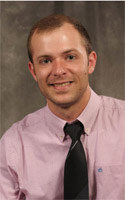 Wesley Turner
Stephen F. Austin State Univerisity
Wesley Turner is a graduate student at Stephen F. Austin State University and is pursuing a MSc degree in Geology with a thesis focusing on the mineralogical controls on hydrocarbon production in unconventional shales utilizing X-Ray diffraction. He completed his BS in Geology in May, 2013, graduating Summa Cum Laude. He is an active member of the student chapters of AAPG and Sigma Gamma Epsilon and has made significant contributions to the development of the East Texas Core Repository. He was an integral member of the Imperial Barrel Award team that represented Stephen F. Austin State University in 2014. In his free time, he enjoys outdoor activities and working towards solutions for complex mathematical of geologic phenomena.
The Wise Report
Henry M. Wise, P.G.
July 5, 2014
The Texas Board of Professional Geoscientists (TBPG) and the Texas Board of Professional Engineers (TBPE) have entered into a Memorandum of Agreement (MOA) in order to implement the requirements of Senate Bill 138. The text can be found at: http://tbpg.state.tx.us/wp-content/uploads/2014/06/Signed-MOA-TBPE.pdf
The TBPG and the Texas Water Development Board (TWDB) recently adopted a revised Memorandum of Agreement (MOA), also to implement the requirements of Senate Bill 138. The text can be found at: http://tbpg.state.tx.us/wp-content/uploads/2014/06/SignedTWDB-TBPG-MOA.pdf
The TBPG is conducting its four-year rule review in 2014. The Board wants to make every effort possible to elicit stakeholder participation in this process. The following proposed amendments have been published in this week’s Texas Register. These proposed rules can be found at: http://www.sos.state.tx.us/texreg/archive/July42014/Proposed%20Rules/22.EXAMINING%20BOARDS.html#42, and http://www.sos.state.tx.us/texreg/archive/July42014/Proposed%20Rules/22.EXAMINING%20BOARDS.html#49
The amendments are mostly proposed to improve language, clarify definitions and to make other minor administrative changes. Several sections are also proposed to be deleted because the TBPG is of the opinion that these sections are not necessary for inclusion in TBPG rules. These rules relate to the TBPG's handling of contested cases, and the provisions in these rules are proposed to be relocated and condensed into §851.201 and §851.202. As noted in the section summary for §851.201 and §851.202, the provisions are reorganized to show that TBPG will abide by SOAH's rules and laws as applicable.
Comments on the proposal may be submitted in writing to Charles Horton, Executive Director, Texas Board of Professional Geoscientists, 333 Guadalupe Street, Tower I-530, Austin, Texas 78701 or by mail to P.O. Box 13225, Austin, Texas 78711 or by e-mail to chorton@tbpg.state.tx.us. When e-mailing comments, please indicate "Comments on Proposed Rules" in the e-mail subject line. Please submit comments within 30 days following publication of the proposal in the Texas Register (published July 4, 2014).
Henry M. Wise, P.G.
The Wise Report
7/5/2014
The Wise Report
Henry M. Wise, P.G.
June 28, 2014
The Louisiana Board of Professional Geoscientists (LBPG) has extended their grandfathering period to the end of this year. It seems the Louisiana Legislature can only make laws effective for the year they were approved. This resulted in the need for the LBPG to request an extension for this year, which is what they originally wanted. The LBPG has also updated their website, www.lbopg.org/home. You can submit, and track, your application there.
The TCEQ Remediation Division issued revised guidance for groundwater monitoring and reporting requirements for LPST sites. The groundwater monitoring and reporting document formerly known as RG-43, Groundwater Monitoring and Reporting has been renamed and is now known as RG-523/PST-06, Groundwater Monitoring and Reporting for LPST Sites.
The Monitoring Event Summary and Status Report (Form TCEQ-0013) used in conjunction with the guidance has also been revised and renamed Groundwater Monitoring Report (Form TCEQ-00013). The report form is required when reporting results from groundwater monitoring activities at LPST sites.
Beginning January 1, 2015 all previous versions of the form will be considered obsolete and will no longer be accepted.
The guidance and report form which is now interactive is available on the TCEQ webpage: http://www.tceq.state.tx.us/remediation/pst_rp/downloads.html#IOM
The TCEQ Remediation Division is also in the process of revising its LPST guidance documents. As the revisions are completed, new Regulatory Guidance (RG) numbers will be assigned to the documents. Therefore, in the near future, all LPST guidance documents will be under RG-523.
Further updates will be made available as guidance documents are revised and made available for distribution. For questions, please contact the PST Program at 512-239-2201 or e-mail at PSTRPR@tceq.texas.gov
Henry M. Wise, P.G.
The Wise Report
6/28/2014

CALL FOR PAPERS
65th GCAGS Convention
September 19-22, 2015
George R. Brown Convention Center
Houston, Texas
To participate in the 2015 GCAGS Convention an abstract of up to 250 words should be submitted no later than December 13, 2014 to Technical Program Chair, Linda Sternbach (linda.sternbach@gmail.com).
After notification of acceptance on January 20, 2015, authors submit extended abstracts (1-2 pages)or full papers up to 12 pages to the GCAGS Transactionsby February 20, 2015 to GCAGS Transactions Editor, Steve Levine. Full instructions for manuscript submissions will be posted online at www.gcags2015.com.

|
| I looked at the need for change in HGS to accommodate how our professional and home lives have changed over time. I did not and do not suggest change simply for its own sake. But I remind you that arguing to keep things as they are for the sake of tradition or because that is always how it has been done is often a way to remain in our comfort zone, whether or not it is just or worthy. Change is not easy for most of us, but is something that must occur for organizations such as HGS to continue to thrive into the future. To the small number of you that have been fighting so hard and vocally against change, I respectfully ask that you redirect your energy from fighting change to remolding the organization and consider how the organization may best be served. Remember that in most cases the needs of the many do out-weigh the needs of the few. I would like to look back a bit and thank those that have helped and contributed. There is always a danger in this. Someone may be left off the list and take offense. Therefore, let me begin by apologizing to those not specifically mentioned, there are only so many words that I am “allowed.” This past year’s board implemented many changes, which I believe will build a strong foundation for others to build on. Most of the changes have been mechanical and are unseen by the membership, but there are others that were very visible. They were all necessary to make us a more business-like organization capable of paying our bills, maintaining our office and permanent staff, and recognizing those individuals that have positively impacted the Society and geology. Through the hard work of a few handfuls of individuals, we have become an organization that is self-sustaining financially rather than an organization waiting for the next cash injection from hosting an AAPG Convention in order to cover our operational costs. This has provided the Board with an increased opportunity to invest in the future, with donations to the Houston Science and Engineering Fair and to both our undergraduate and graduate scholarship programs, as well as AAPG’s Imperial Barrel Award program. This financial freedom has largely come about as a result of the two successful technical conferences — Geomechanics and Mudstones. I cannot thank enough the organizing committees and especially Frank Walles. His approach has brought to the Society top-tier technical programs and has made these conferences selfsustaining. Several of those involved will be recognized by the Society (see the awards citations in this month’s Bulletin). Our permanent staff of Sandra Babcock, Troy Fearnow,and Jill Kimblehas also been an integral part of this year’s success. They worked hard to deal with our membership rosters, identifying a large group of “lost” members and recapturing them. As a result of their actions our membership hovers around 4000. They have also been engaged with the details of each of our events, whether it was a monthly meeting, technical conference, social activity, or AAPG Convention. Special thanks must go to Sandra in her role as office director. She has been my sounding board, cheerleader, and corporate memory. The Board this year was quite engaged. I would like to list all of their accomplishments, but I can only cite a few. Mike Erpenbeck altered the way our finances are presented to the Board. No longer were we simply checking what the balances were of our various accounts but we were looking at trends and projections of income and expenditures. The picture he presented each month allowed us to get ahead of the curve. Mike Demingdid a look back on meetings and began the process of revamping the cost structure and meeting schedule. John Dombrowski finalized our transition to the new website and attempted to herd the group of cats, also known as the Houston delegation of the AAPG House of Delegates. Bryan Guzmanpresented a view of the young professional and as expected it was often very different from those placing a capstone on their career. Beverly DeJarnettensured our involvement with AAPG’s technical program through short courses and field trips. The three HGS-sponsored events not only provided learning opportunities but contributed to our bottom line. Ken Nemethwas instrumental in our review of the Society’s awards. He helped search out the history of the awards and aided in our course correction, making sure that all deserving were recognized. Awards and honors are quite important to an organization such as HGS because they let our volunteers know how much they are appreciated. And, Mike Forlenza returned to the Board through appointment to take on the thankless job of Editor. He chased down content, including mine, and assembled a monthly Bulletin that we can all be proud of. And finally, there is one special person to thank, my wife, Terry. She continues to be my sounding board often reminding me that it is not only what you say and write but the tone that is important. She has been and continues to be my editor. This began with my dissertation and continues with these columns. She has always been an advisor helping with many difficult decisions as well as being a calming influence. But most of all she has been patient and forgiving. The time that I spent at meetings, handling society business, or even writing these columns has been hers. Thank you. Thank you. Thank you. I have typically closed with “...until next month”, but there is no next month for me so let me simply say I thank you all for the opportunity that you have given me to serve. But I can assure you that unlike old soldiers, I will not simply fade away. |
|
| After telling someone that you are a geologist, they will reply something like: “Oh, that is something to do with rocks.” Well, yes, OK. Discussion of the topic generally ends at that point. But one can hardly blame the non-geologist for his vague sense of what a geologist does. The world of earth science is arcane to most people. And there are few prominent geologists communicating with the public through the media about the professional contributions of geoscientists or acting as champions of the science.
|
The Wise Report
Henry M. Wise, P.G.
May 24, 2014
Following its determination that the National Ground Water Association (NGWA) properly met its standard development process, the American National Standards Institute (ANSI) has approved, pending a 15-day appeal period, for NGWA to issue ANSI/NGWA-01-14, a water well construction standard. NGWA's first-ever third-party sanctioned standard, ANSI/NGWA-01-14 sets a baseline of expectations for water well system professionals to meet for residential, agricultural, monitoring, industrial, and public supply water wells. The standard seeks to contribute to public health and safety, resource protection, and to serve as an outcomes focus for NGWA's voluntary water well system professional certification program.
Topics covered by the ANSI/NGWA standard include:
• Well site selection
• Casing and casing installation
• Well screens, filter pack, and formation stabilizer
• Grouting
• Plumbness and alignment
• Well development
• Testing for performance
• Data recording
• Disinfection with chlorine
• Water sampling and analysis
• Permanent well and test-hole decommissioning.
Thom M. Hanna, RPG, a member of NGWA's Standards Development Oversight Committee, said the standard will provide minimum criteria to anyone who needs guidance on properly designed and constructed well systems.
It will be available in the NGWA bookstore in the near future. For more information, contact Jessica Rhoads, NGWA industry practices administrator, at jrhoads@ngwa.org or by calling 800 551.7379, ext. 511.
Henry M. Wise, P.G.
The Wise Report
5/24/2014
The Wise Report
Henry M. Wise, P.G.
May 18, 2014
Justin McNamee passed away on April 18, 2014. Mr McNamee was appointed by Governor Perry to the Texas Board of Professional Geoscientists (TBPG) to a six year term in a position reserved for the public (someone who is not a Licensed Geoscientist). Mr. McNamee was born on July 31, 1958 in Dallas, Texas. He attended and received his Bachelor’s Degree at the University of Texas at Arlington. Mr. McNamee was a community leader who gave to the community his time to numerous charitable and civic groups.
Mr. McNamee is survived by his wife and his two children. In lieu of flowers, memorial donations may be made to the Justin Lynn McNamee Scholarship Fund benefitting the children and youth ministries at Highland Oaks Church of Christ, Highland Oaks Church of Christ, 10805 Walnut Hill Lane, Dallas, TX 75238.
---------------------------------------------------------------------------------------------------------------------------------------------------------------------
The Texas Commission on Environmental Quality (TCEQ) has updated the aquatic life and human health surface water RBEL (risk-based exposure limit) tables. These tables are available at the fourth bullet at the following link: http://www.tceq.state.tx.us/remediation/trrp/trrppcls.html.
They are also available as companion documents to, “Determining PCLs for Surface Water and Sediment (TRRP-24)” which is available with the TRRP guidance documents at: http://www.tceq.state.tx.us/remediation/trrp/guidance.html.
The following changes were made to the aquatic life table:
The following changes were made to the human health table:
The aquatic life and surface water RBEL tables will be updated periodically to reflect new state or federal criteria, changes to ecological screening benchmarks, and/or other information (e.g., toxicological data, persistence information). These revised tables should be used for TRRP submittals that involve releases to surface water. For additional information on the surface water RBEL tables, contact Vickie Reat at vickie.reat@tceq.texas.gov.
Henry M. Wise, P.G.
The Wise Report
5/18/2014

|
| First, there is a need to volunteer. Volunteers remain the life blood of professional organizations such as the Houston Geological Society. Without committee chairs and active committee members and officers, HGS either would not function or, alternatively, the cost of membership would be so high that individuals would no longer continue to be dues paying members. The costs associated with the paid staff necessary to replace our volunteers would be astronomical. At some point in our careers, we have all benefited from this organization or some other professional organization, directly or indirectly. HGS provides opportunities for training, professional development, and networking. It is only fair that we give something back, and that is more than just returning our dues payment of $24.00. Remember, that it is a small group of volunteers that search out the presenters for the multiple meetings that we conduct each month, organize short courses and major conferences, conduct our outreach programs, and aid in maintaining the business functions of the organization. There is a continual need to refresh the ranks of these individuals. Responsibilities change at the office. People are relocated. People retire. Consider giving a little so that we may all benefit! Until next time... |
| |
|
The Texas Commission on Environmental Quality says that Mexico is behind on delivering the water under the terms of the treaty and owes the U.S. 471,000 acre-feet of water. According to June 2013 reporting in the Texas Tribune by Julian Aquilar, Mexico only provided 49 percent of its obligation in 2012 only 6 percent in 2013.
|
Field Trip to Spindletop Museum in Beaumont
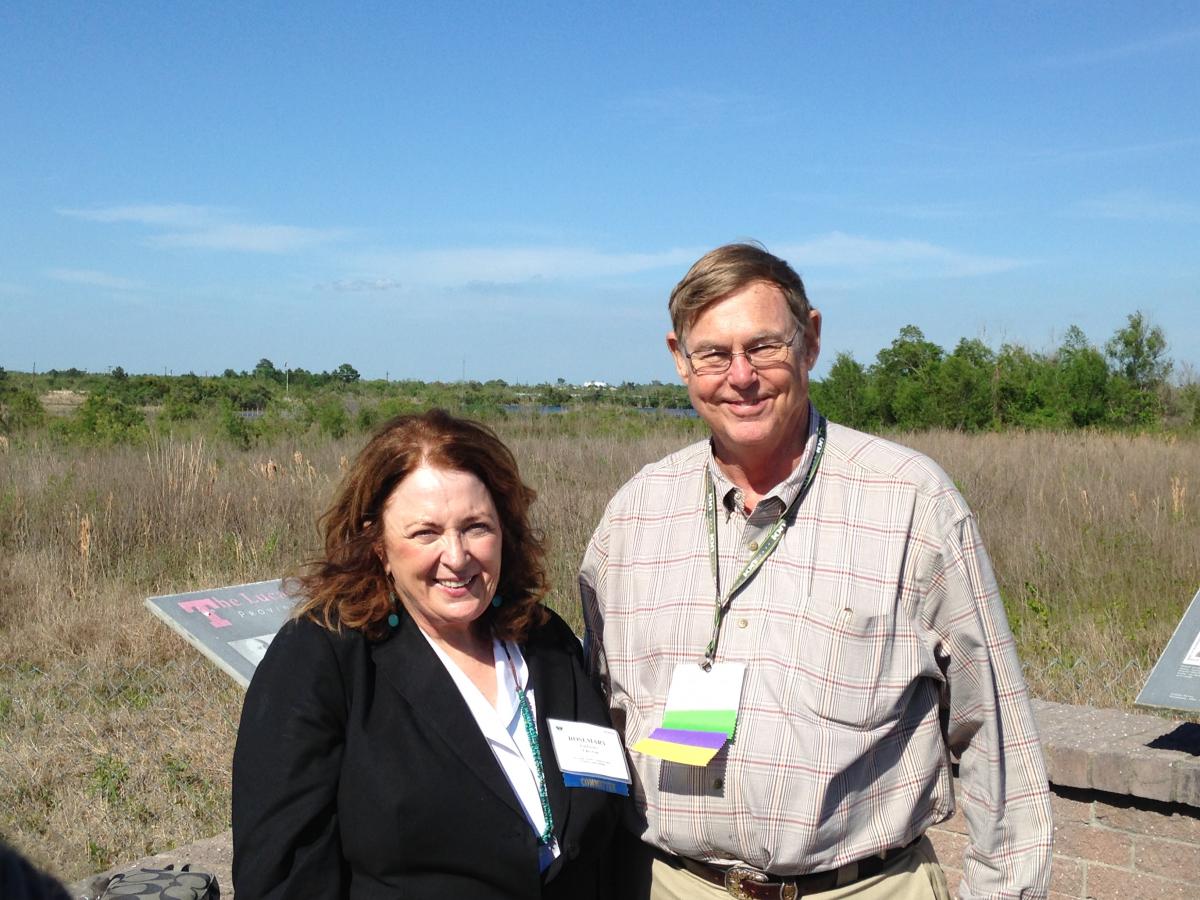
Photo taken looking at the site of the 1901 Spindletop blow out well.
Rosemary Laidacker and Robert Pledger organized an interesting field trip that took place after the AAPG Houston convention on Thursday, April 9. Forty-one geoscientists and history buffs traveled by bus to Beaumont, Texas, to see historical relicts of the early pioneer days of the oil industry.
The first stop was the Texas Energy Museum; at 600 Main Street, in Beaumont Texas , off I-10. During the drive, the group watched a video about the discovery of Spindletop oil , created for the 100th anniversary of the famous oil blowout on January 10, 1901. The Spindletop oil discovery is historically significant because it was the first US well to produce 100,000 barrels oil per day. The discovery ushered in new wealth, technology and rocketed the state of Texas to national prominence. The Texas Museum has two floors of displays relating to early Texas oil drilling, production and refining. The group was fascinated by the seismic line wall murals over the Spindletop Dome. More information is at www.texasenergymuseum.org.

Charles Sternbach, Linda Sternbach and Robert Pledger

The group then drove to the Gladys City Boomtown Museum on the campus of Lamar University in Beaumont. The Gladys City website is www.spindletop.org. Chairman of the Lamar Earth Science Department, Dr. Jim Jordan, talked to the group, followed by the President of Lamar University , Ken Evans . They discussed the geology education programs and university efforts to support student education.
Field trip leader Rosemary Laidacker introduced a fascinating new historical book about the discovery of Spindletop. The people and time period come to life in the book “Giant Under the Hill” by Judith Walker Linsley, Ellen Walker Rienstra and Jo Ann Stiles. The book is available at Amazon.com for $20 and through Texas State Historical Association in Austin (http://www.tshaonline.org/)
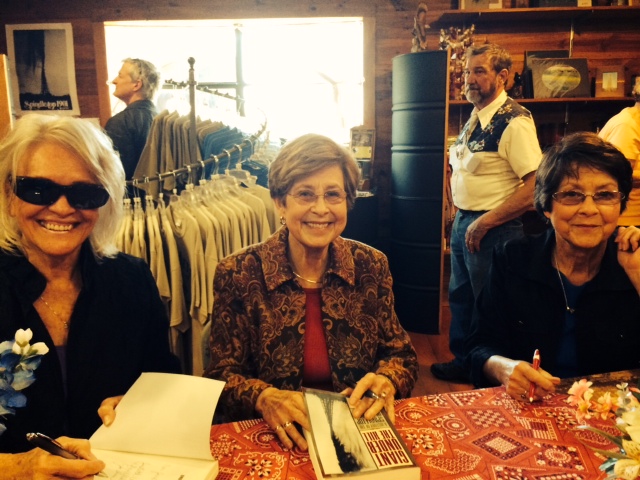
Book authors of “Giant Under the Hill” from left to right: Jo Ann Stiles, Ellen Walker Rienstra, and Judith Walker Linsley.
“Giant Under the Hill” explains the events leading up to the discovery and raging oil blowout of the “Lucas Gusher.” Historical characters include Patillo Higgins, the man who dreamed of finding oil on Big Hill or Spindletop; and Captain Anthony Lucas, who made the drilling of the discovery well possible. The authors talked to the attendees for several hours about the timeline of the oil discovery. As Jo Ann Stiles said, the story includes all possible literary dramatic elements: dreamers, bankers, businessmen, intrigue, love, death, riches and bankruptcy.
Robert Pledger gave a presentation on the geology and geophysics of the Spindletop dome and the discovery of oil. The original discovery found in 1901 produced over- pressured oil out of the cap rock at 1102 ft. In 1926 another pool of oil was discovered by drilling on the flanks of the subsurface salt dome. Pledger’s company continues to search for more oil in the Spindletop dome area.
Samples of the gypsum and anhydrite cap rock were shown in the room. Prior to the discovery the Hill was known to have surface gas seeps with Patillo Higgins lit on fire. Geologists knew oil accumulated in anticlines, but did not associate oil with Texas hills and salt domes. Many geologists before 1901 dismissed Patillo Higgins attempts to convince investors that Big Hill (Spindletop) had oil. Anthony Lucas believed Higgins but had to invent new drilling techniques (like the rotary bit) to be able to drill to 1101 feet.
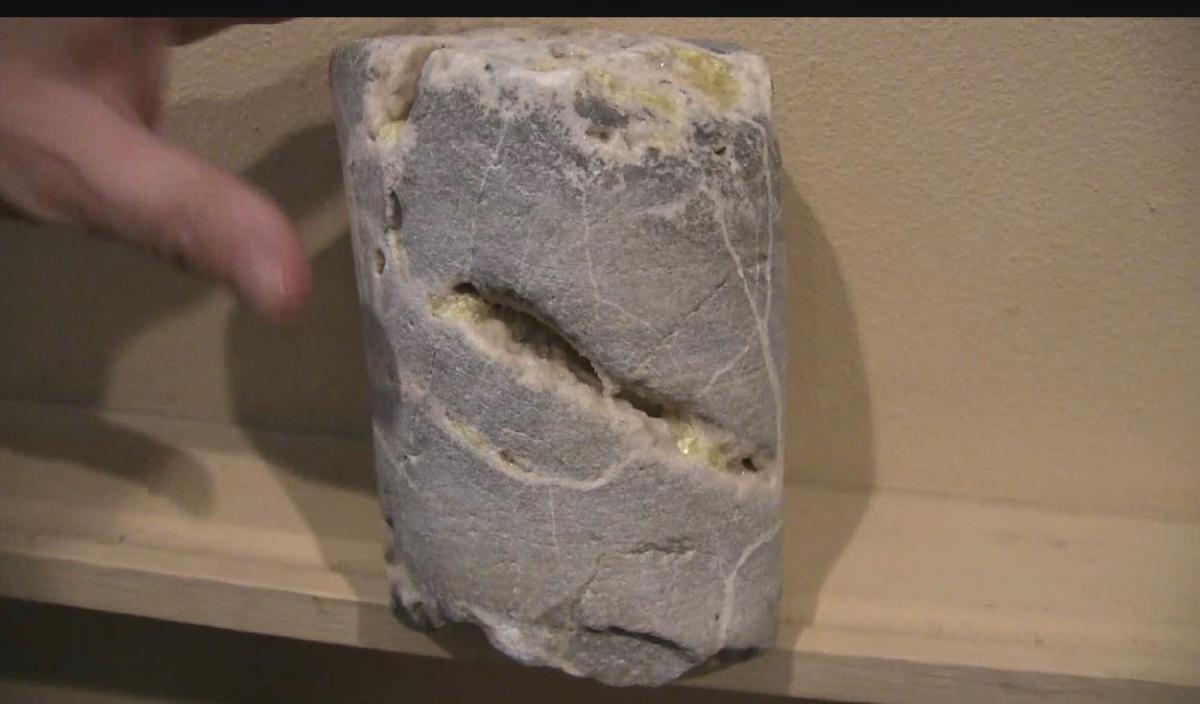
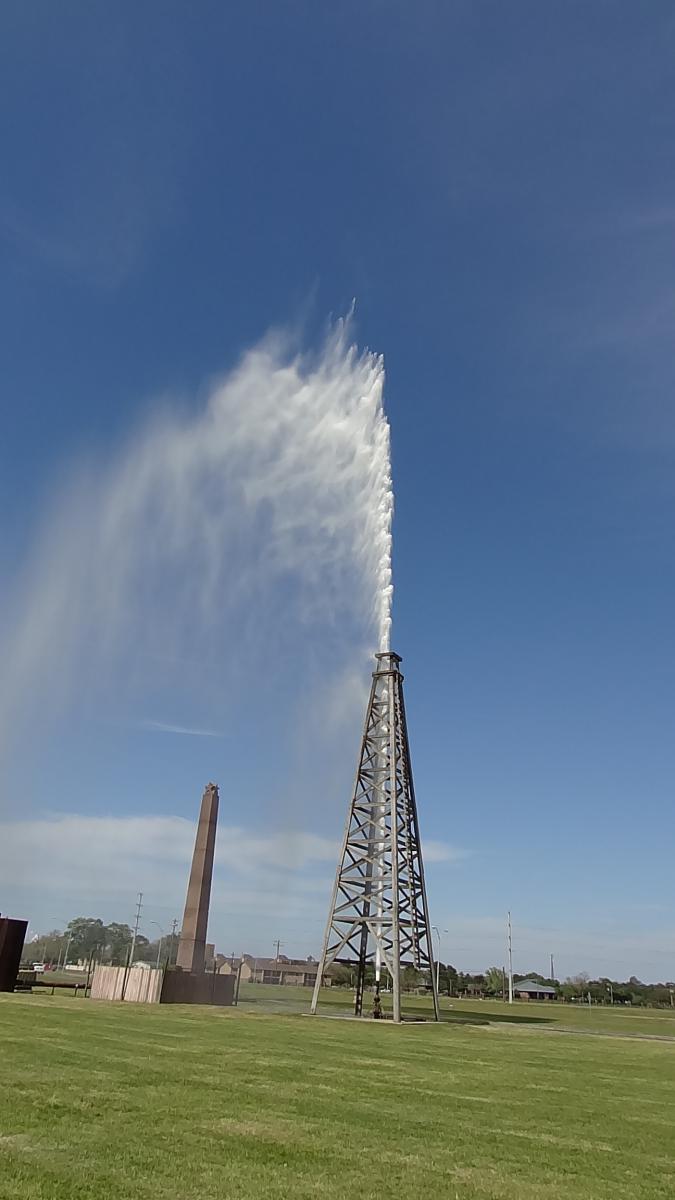
Everybody on the field trip enjoyed a short drive to the site of the Spindletop blowout off the 1-10 highway. Oil wells with rocking pumpers still produce oil from this historical oil field, over 114 later.
The Gladys City Museum has a daily recreation of the Spindletop blowout. The group witnessed a 10 minute blowout recreation, where water shoots over a wooden rig 100 feet into the air.
HGS Night at the Museum Entertains AAPG attendees on April 8
By Linda and Charles Sternbach
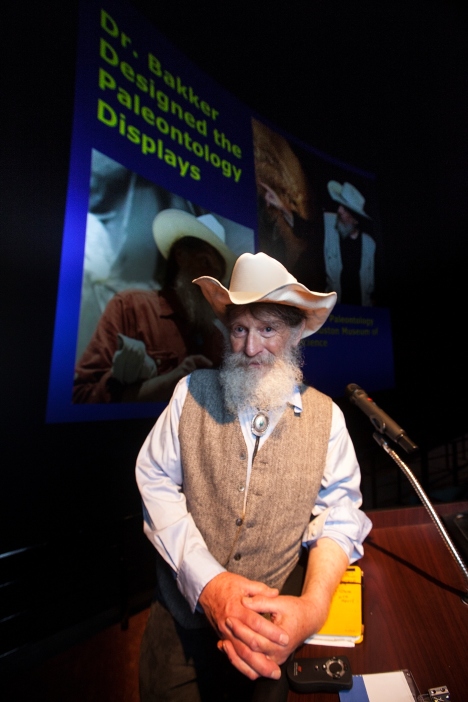
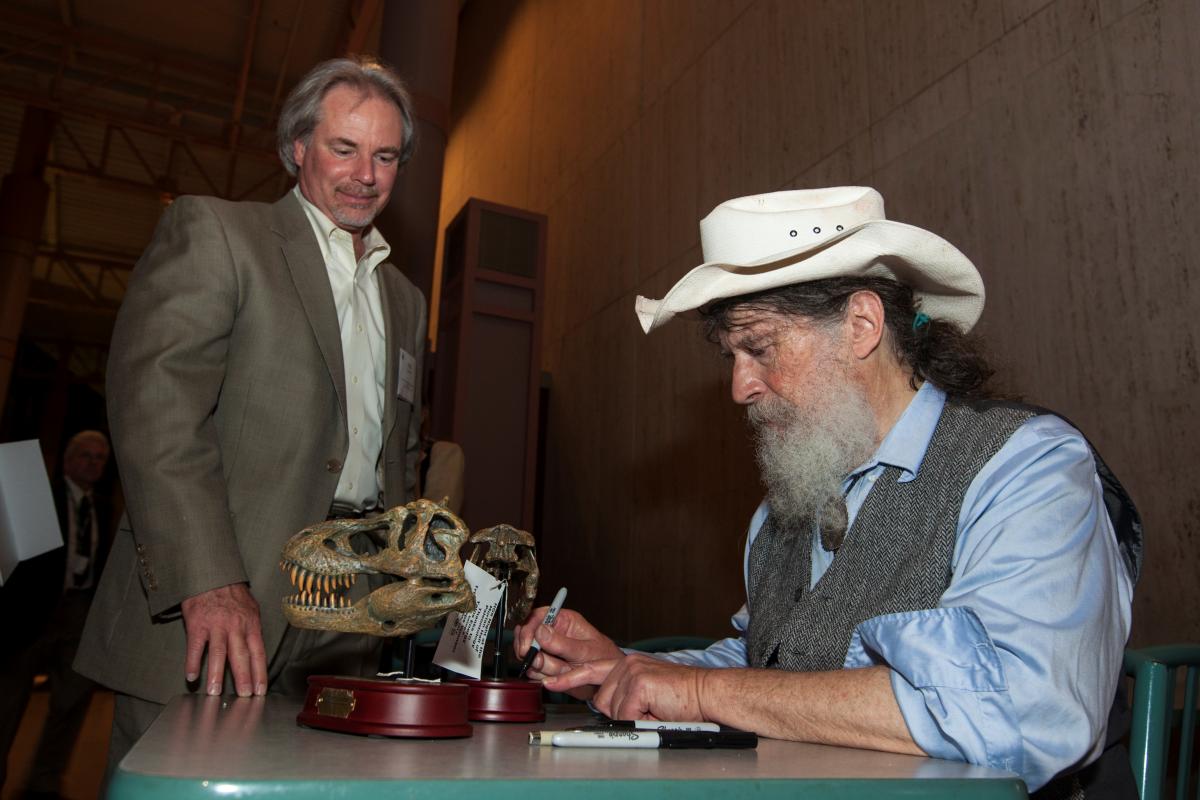
A sell-out crowd of 420 enthusiastic geoscientists and friends filled the Morian Hall of Paleontology at the Houston Museum of Natural Science on April 8. The HGS hosted a social evening during the AAPG annual convention on Tuesday night that featured a presentation by famous paleontologist Dr. Robert T. Bakker. Bakker is also Curator of Paleontology at the HMNS science museum. Attendees roamed among the large dinosaur displays of the Paula and Rusty Walter Mesozoic Gallery, enjoyed a buffet dinner and took photos. This was the first time that attendees to an AAPG annual convention, hosted in Houston, had the opportunity to see the dinosaur exhibits, which were created in 2012 under Dr. Bakkers’ supervision. About 200 of the 420 people who came to the Museum were from outside the Gulf Coast area, and many attendees saw the paleontology exhibit for the first time. The AAPG convention brought geoscientists to the social event from England, Mexico, Canada, and even New Zealand. Many participants expressed interest in joining both HGS and the HMNS.
 | 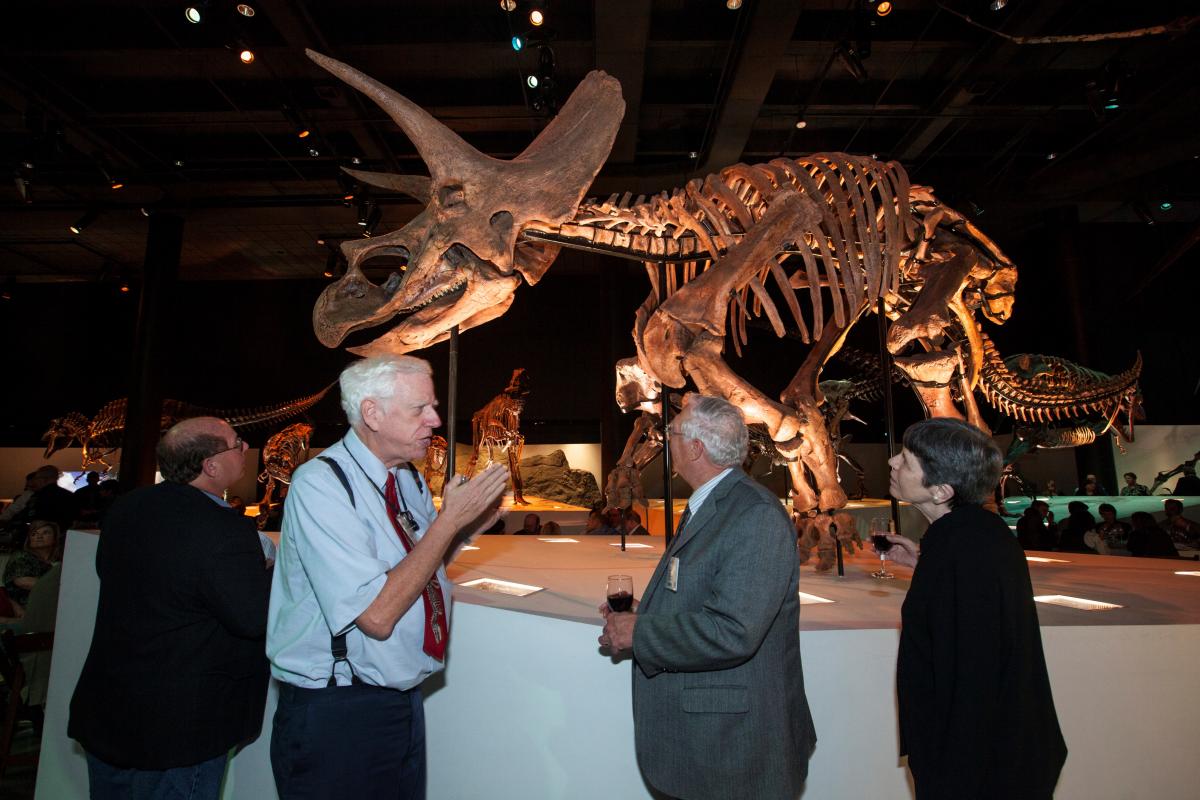 |
| Dr Robert T Bakker | Neal Immega |
Dr. Bakker summarized his presentation as a "geo-narrative of the Hall.” Bakker said,” I talked about how we arranged fossils to tell the story of progressive evolution. I researched our own Texas Red Beds (in Seymour, Texas) and found that fin-backed fossils surprise us. Their teeth and jaws got better and better bio-mechanically over time. Texas bones prove that all us Mammalia, the hairy-warm-blooded-milk-producing Class, came from very early land reptiles of the greater Dimetrodon clan".
Geoscientists can keep up with Dr. Bakker’s research at the Museum “Beyond Bones” blog at:
https://blog.hmns.org/category/paleontology/
Many participants were able to meet Dr. Bakker and get his books personally autographed. These included his new “Golden Book of Dinosaurs” and his classic 1986 book, “Dinosaur Heresies,” both of which are also available as hardcopy from book sellers.
 |  |
| McArdle (center) |
The evening was made possible by a generous donation by Rusty and Paula Walter, and Walter Oil and Gas. Special thanks are due to Mike Jobe, past HGS board member and employee at Walter Oil and Gas for coordinating funding. In addition, generous support from Exxon Mobil, and Talos Energy, faciliated by John Adamick, further underwrote HGS graduate and undergraduate scholarships.
Many HGS volunteers helped make the HGS Night at the Museum a success. Thanks to Linda and Charles Sternbach who conceived of the event, booked Dr. Bakker,and reserved the date on the HMNS calendar a year and a half ahead of time, with the help of HGS past President Martin Cassidy. Sandy Rushworth and David Risch assembled a volunteer team to check in guests. Inda Immega recruited the Museum “docents”, trained volunteer experts on museum displays, to give presentations to guests. The docents included Neal Immega, Janet Combes, Michael Quintaro, Shirley Smalley, Gretchen Sparks, Richard Spaw and Diane Vitaska. Dawne Jordan coordinated the bus rental for the event. Lucy Plant and Alex Blaque helped with bus arrival and departure from the George R Brown Convention center on the night of April 8. Thanks to David Temple, associated curator of the Museum for arranging Dr. Bakker’s schedule and travel.
Heather McArdle is a Mahopac High School, New York geosciences teacher. Heather is the 2014 AAPG Teacher of the Year, following an award ceremony during theAAPG convention. She attended the HGS Night at the Museum and wrote the following letter: "The exhibits and docents were amazing. We found that our time at the AAPG Conference was exceptional. We've decided to return in the future. The HMNS museum is definitely on the list!”

Thanks to Sponsors Walter Oil and Gas, Exxon and Talos Energy





 Presidential Ponderings
 Some Closing Thoughts
 ites like Albert Einstein. Chemists, biologists, physicists, and medical researchers get their moment in the spotlight each year during the awarding of the Nobel prizes. Geologists labor in relative obscurity.
 An early portrayal of this type of geologist, familiar to children, was the rambunctious Yukon Cornelius in the 1964 television Christmas classic, the stop-motion animated Rudolph the RedNosed Reindeer. Y. Cornelius was a rough and capable prospector who could taste precious metals and ores on his rock hammer. He was heavily bearded, wore field boots and clothes, had a confident and optimistic attitude, and even carried a pistol in his belt. He was a pretty cool geologist, but not really an accurate depiction of a modern geologist.
 In the hit comedy television series The Big Bang Theoryon CBS, Dr. Sheldon Cooper, the socially awkward genius theoretical physicist, often disparages the other “softer” sciences. In Episode 1 of Season 5, Dr. Cooper and his physicist colleagues take on the geology department in a spirited paintball contest in the woods. At a critical moment, Dr. Cooper charges into the open and shouts, “Geology isn’t a REAL science!” This draws the wrath of the earth scientists who unleash a multi-colored paintball fusillade in retaliation. Filmed in slow motion, the scene is an homage to the Sergeant Elias (Willem Dafoe) death scene from the movie Platoon. Later in the series, Dr. Cooper remarks, “Geology is the Kardashians of science.” Ouch.
 Needless to say, most of these portrayals of geology and geologists are rather light on the science. So much so, that even second year geology students are likely to roll their eyes and become exasperated at some of the science gaffes and fabrications.
 earns of the top-secret project “DESTINI” (Deep Earth Seismic Trigger INItiative), which was designed as a weapon to propagate earthquakes through the Earth’s core. But in its first activation, the weapon unintentionally stopped the core’s rotation instead. The government has plans to use it again to attempt a restart of the core if the mission fails.
 Dante’s Peak, a somewhat more plausible geology story, features hunky Pierce Brosnan as Dr. Harry Dalton, a vulcanologist with the United States Geological Survey. Dr. Dalton arrives at the Washington state countryside area, named Dante’s Peak after a long dormant volcano, which has recently been named the second most desirable place to live in America and discovers that Dante’s Peak, may wake up at any moment. Matt Herod, on his geology blog GeoSphere, provides this movie analysis: “There is not a whole lot of actual geology in Dante’s Peak, but despite that Pierce delivers an excellent performance as the ‘whistle-blowing geologist’ that no one wants to listen to until it is too late. It is also another great media stereotype of geologists as nerdy, but rugged, people who care more about rocks, water and gases than people.”
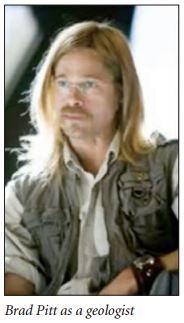 Another interesting cinematic portrayal of a geologist is found in the caper Ocean’s Thirteen. To plant a camera in the casino boss’s office, Brad Pitt pretends to be a geologist with a warning about a hidden fault line under the building. Mr. Pitt’s appearance is a bit of a spoof, an over-exaggeration of how Hollywood thinks that the public thinks that a geologist would look. He, of course, is bespectacled, dressed in a battered field clothes (vest and shorts), and sports a very large leather watch band. He is somewhat unkempt with scraggly facial hair.
 Paleontologists
 Geologists and Beer
 The most popular theory, based on Ms. Mason’s interviews with the conference attendees, was that the connection has something to do with the amount of time spent outside doing fieldwork. “When it’s hot, and you’ve been hiking all day carrying 50 pounds of rocks, do you want a Merlot?” asked thermochronologist Jim Metcalf of Syracuse University. “No.”
 John McPhee is widely considered one of the pioneers of creative nonfiction. He is a four-time finalist for the Pulitzer Prize in the category General Nonfiction and won that award on the fourth occasion in 1999. In 2008, he received the George Polk Career Award for his “indelible mark on American journalism during his nearly half-century career.” Since 1974, Mr. McPhee has been the Ferris Professor of Journalism at Princeton University.
 Simon Winchester, Order of the British Empire (OBE), is a British-born author and journalist who resides in the United States. During his career at The Guardian, Mr. Winchester covered numerous significant events, including Bloody Sunday and the Watergate scandal. As an author, Winchester has written or contributed to more than a dozen non-fiction books and his articles have appeared in several travel publications, including Condé Nast Traveler, Smithsonian Magazine, and National Geographic.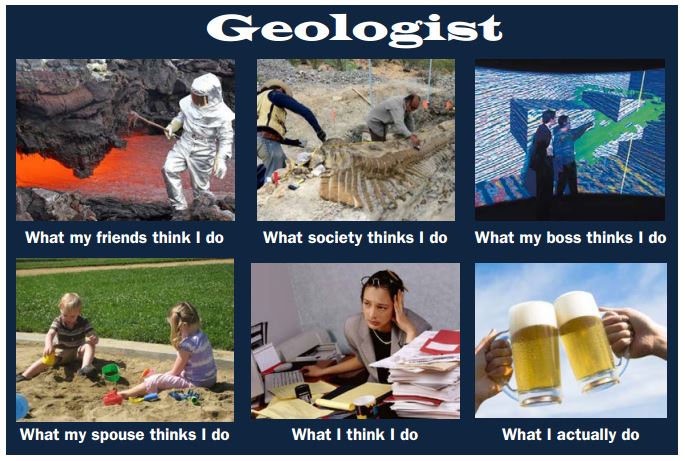
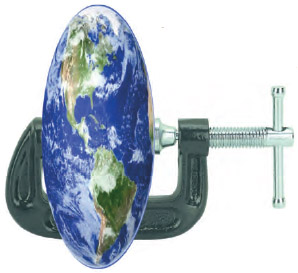
 Fortunes have been made in Texas, Arizona, California, Nevada, and New Mexico in agriculture, ranching, mining, gaming, recreation, energy, and development. For many decades, fast-growing, sun-washed cities in the region attracted people seeking a place to start anew and prosper. Cheap land and available resources lured entrepreneurs, retirees, recreationists, and businesses to this arid land. This frenzy of growth was lubricated by seemingly limitless supplies of fresh water pumped from relict groundwater or transported across the baked landscape by vast government projects. This cheap supply kept electrical generating facilities humming, maintained verdant lawns and golf courses, filled shimmering reservoirs, and slaked the thirst of lush fields of cotton, grain, fruits, and vegetables.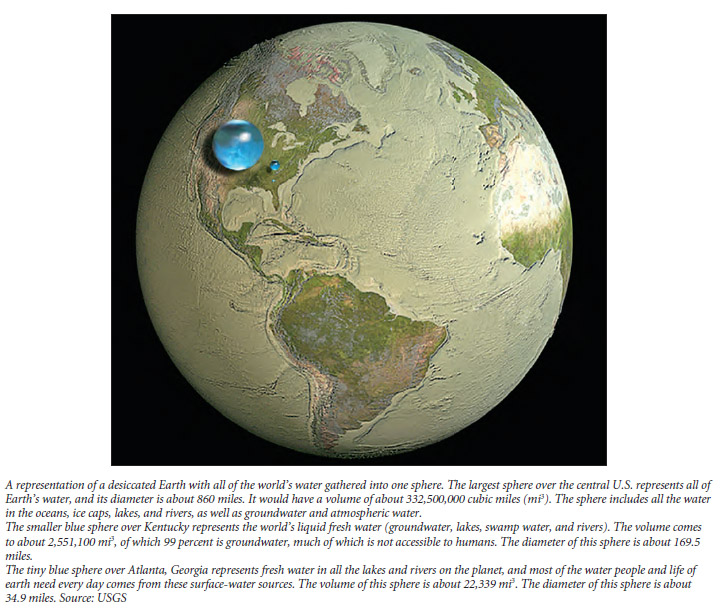
 New Mexico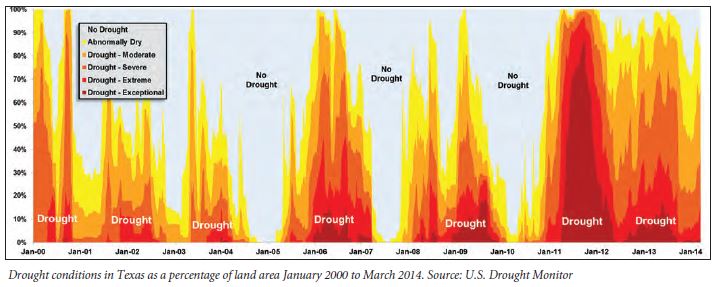
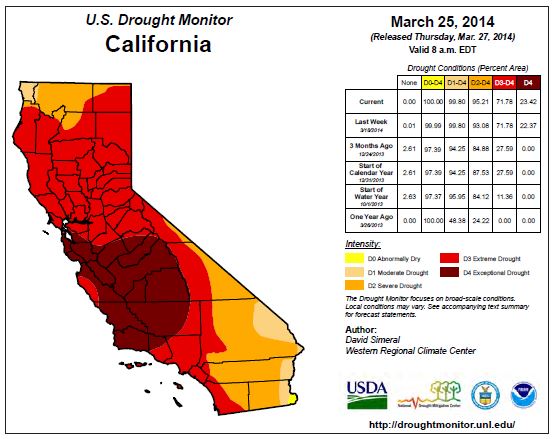
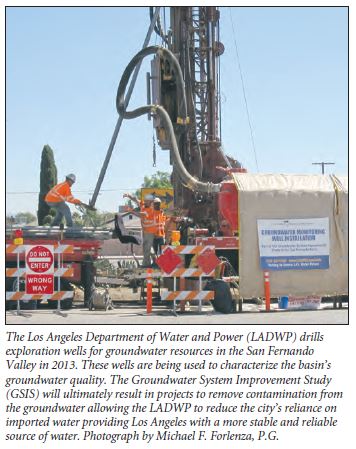 Kate Galbraith, in a March 2014 column titled “America’s Axis of Drought,” on the news website the Daily Beast, noted some similarities between the two most populous states, California and Texas, during their driest years. Both are major agricultural states that do not regulate groundwater use at the state level. Both have published lists of mostly rural towns where the taps could run dry. And both experienced massive wildfires causing large amounts of property damage. But perhaps the biggest lesson from Texas is that severe droughts can drag on long past the time when the hills turn green.
 Conservation is a strategy that can be implemented by any community to slow the growth of water demand. Conservation measures involving reduction of water losses during transmission and distribution, use of more efficient household appliances, and use of drought tolerant native plantings to reduce landscaping irrigation produce immediate benefits. Other near-term measures can be a switch to more efficient agricultural irrigation methods such as drip irrigation or developing strategic water pricing to more closely reflect the true value of the resource. Price is a very powerful motivator. When something costs more, people use less.